Wednesday, August 24, 2011

How to raise test scores

Regular readers of the ROLE Reversal blog may be shocked at the title of this post, knowing how ardently I oppose high stakes testing. Fear not, I have not been transformed into a traditional teacher or bureaucrat, who believes that standardized testing is the best way to evaluate learning.


Photo credit: Nursingcrib.com
However, after hearing my superintendent browbeat his staff for poor returns on last year's test and subsequently listening to colleagues say we need a plan for better high stakes test scores this year, I began to ponder this issue. Even though I loathe the test, we're stuck with it, so I figured why not tell my colleagues how to raise their students' scores.

I shared how my students pass at a higher rate than their peers in traditional classes. So, what strategies do I use to prepare my students for the test, I was asked.

"Simple," I say," I do nothing. I never talk about the test. I don't teach test-taking strategies, and I don't review practice test results."

After a silent moment of astonishment, I explained that my Results Only Learning Environment is built on developing a thirst for learning. Students work on projects, they collaborate and, most importantly, they read all year. With minimal help from me, they develop the skills they need to pass any test.

So, if you want to improve scores on high stakes tests, the easiest way is to stop teaching to the test. Throw out your remedial programs and stop designating the failing students as "failures," or those "at-risk of failing." Treat all of your students the same. Get them to love learning, and they'll begin learning.

When the standardized test arrives, tell students you know they'll do well, because they have learned.

It really is this simple.

Tuesday, August 23, 2011

When administration sucks the life out of teachers

The new school year started yesterday with our usual district-wide convocation. This is when all teachers and staff meet in our high school's auditorium to hear the superintendent talk about the coming year.

Sadly, in recent years, this has become a time to discuss our failings on the state-mandated standardized test.


Courtesy: Penn Political Review
Year after year, it's the same thing: we're labeled as "average," "below average" "above average," or "excellent." The "good" schools are praised, and the "below average" ones are vilified in front of the entire districts and local politicians. Then, we're informed that this year will be different, because we have some tremendous new program that will magically get students to pass the test.

All this manages to do is suck the life out of teachers. Instead of looking forward to the energy and fresh ideas that most teachers return with, teachers head back to their respective buildings, with their heads held low and their vigor crushed.

When administration sucks the life out of teachers, it makes for a horrible way to start a new school year.

Monday, August 22, 2011

Rethinking tests and quizzes

"Today, we'll have a pop quiz." Back in my days as a traditional teacher, I loved this sentence. There was a sense of power and control, when I surprised my students with some sort of test of knowledge over something we'd recently studied or of a chapter in some boring book I had demanded that they read.

By its most basic definition, the pop quiz is nothing more than a stick, used to punish students. It's not much better than the paddle, teachers used back in the days of corporal punishment. Students are asked to complete some basic task, and then they are tested on the knowledge they retained in a short period of time. If they have not completed the task, they fail the quiz.

Tests are not much different. Students study information the teacher provides, and they are given a list of questions created by the teacher, based on the information that was delivered. The teacher has all of the control -- one reason that tests masquerade as objective assessments, when they are, in fact, very subjective.

If we are to reform our failing education system, it's time to rethink tests and quizzes. To simplify things, the first step should be to eliminate quizzes entirely, as they serve no educational purpose. As Jerome Bruner wrote, teachers should help students "experience success and failure not as a reward and punishment, but as information (The Act of Discovery, 1961)."

So, let's concentrate on tests. Although project-based assessment is the best way to evaluate learning, tests can provide the information, of which Bruner writes.

The key to making good use of a test is to use it strictly as a diagnostic tool. In fact, the word "test" should be replaced with diagnostic. Students should be taught that a diagnostic tool, especially one that contains multiple choice items, is only part of assessment.

Because tests are unreliable and subjective, the results should never be part of a grade, and they should be used to evaluate which learning outcomes need more attention from the teacher. Rather than looking at test results in terms of individual students, they should be considered holistically. So, if 40 percent of a class misses number 8 on a diagnostic, there is either a problem with the item, or the learning outcome needs to be revisited.

When tests are used in this fashion, strictly as diagnostic tools, they become one useful part of evaluation of learning.

Look for more on this subject at this post on raising test scores.

Sunday, August 21, 2011

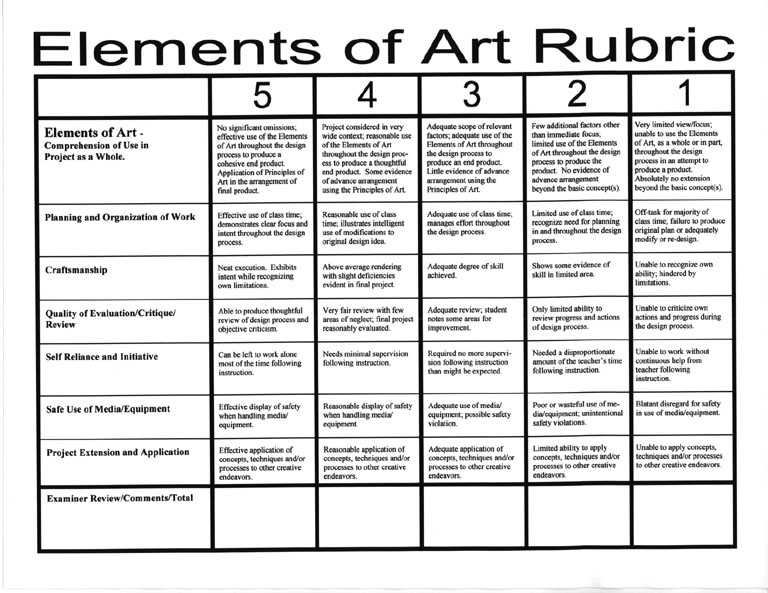
Rubrics fail students as much as grades

Rubrics are popular assessment tools for many teachers. Like grades and other traditional assessment methods, rubrics fail students.

The problem with rubrics, like letter and number grades, is that they are a one-size-fits-all form of assessment and they are subjective. Rubrics use words like, "seems," "little," "mostly," "adequate," "some" and "weak," to name a few.

Although narrative feedback, the method of assessment that should eliminate grades and rubrics, may use subjective words in some cases, the feedback is far more specific and individualized. If the feedback says, "Very well done overall," this will be followed up with a careful explanation of what was done well. Rubrics don't do this, so even students who meet the learning outcomes don't know how they did it, based on a rubric. Consequently, learning is lost.

For example, on a major project, a part of a rubric may say, "Work displays adequate attention to detail." This statement has virtually no meaning. I'm not sure what "displays" means in this context, and "adequate" is a completely inadequate word in virtually every case. Finally, vague statements like this do not explain what detail the teacher wants.

If providing meaningful narrative feedback, I would mention the detail specifically. If it's a science project on hurricanes, I might say or write something like: 
"Your project only partially demonstrates that you understand hot towers, based on the lessons and models from class. You need to add two or more captions to your drawing, explaining how the towers power the hurricane. Please make the necessary changes and resubmit."
Not only does this feedback specify what is missing, it asks the student to return to the work, make changes and resubmit.

Because a rubric is a one-size-fits-all tool, it does not meet the needs of each individual and, consequently, fails students.

Saturday, August 20, 2011

Summer reading tests kill interest in reading

Years ago, when I taught with traditional methods, I started the school  year with summer reading worksheets and a test. The test typically composed 20 percent of the first marking period's grade. As is the case with other archaic methods, such as homework and tests, this put students in a peril, as far as their grades were concerned.


Flickr Creative Commons license
The aforementioned is why most assessment of summer reading kills students' interest in reading in general, and summer reading, in particular.

When I converted to a Results Only Learning Environment, I did away with the worksheets and tests over summer reading. This was only one step to engaging students in reading during their lengthy sun-baked breaks, though.

We used to assign one or two novels, and demand that students prepare summaries on them and take a summative assessment within the first week or two of the school year. Since many students failed to read the books, they started the year with a failing grade.

Teaching in a ROLE showed me that student autonomy is the most important element of developing a thirst for learning. So, my colleagues and I created a long list of books at various reading levels and asked our students to choose from the list. If they couldn't find something they loved (this almost never happens), they could choose a book of their own. We just wanted them to read and, more importantly, develop a love of reading.

Now, when the school year begins, we ask students to complete a project, complete with a huge menu of choices for demonstrating learning. There is never a summary and never a test. Students enjoy sharing their reading experiences in creative ways, and reading becomes fun.

Friday, August 19, 2011

ROLE discussed on TED site


Flickr Creative Commons license
The amazing debate about eliminating grades that I moderated on TED.com last month sparked plenty of conversation about results-only learning.

With this scintillating debate in mind, I started a new TED discussion about creating Results Only Learning Environments world wide.

I hope you'll weigh in on this important conversation. Also, please share it with your PLN.


Wednesday, August 17, 2011

Why high stakes testing is all about money

Today, I received correspondence in my school e-mail inbox from a company, promising to increase student achievement on our state-mandated standardized test.

For the small price of $1,495, Coach Publishing declares, I can plop my students on computers and have them take practice test after practice test. Oh, but there's more: for my slightly-less-than-$1,500 investment, the company will also give me real-time test results and customized skills practice.


Courtesy eHow.com
If one wonders why it's so difficult to get bureaucrats -- the same ones who blame teachers for the problems in education -- to understand what's wrong with high stakes testing, there is no better evidence than this. Politics is about lobbyists, and education has no bigger lobby than the opportunists who keep producing these useless test-taking programs at exorbitant prices.

Let's see, for $1,500, I could purchase 400-700 paperback novels. If I do nothing more than put the books in my students hands and tell them to read all year, they will still outperform their peers, who use software systems, like the one referenced above.

It doesn't matter, though, because high stakes testing is a big money business. So, while the testing lobby makes billions, our students suffer.